Welcome to the National Business Case Study Competition 2027
Introduction to the Competition.
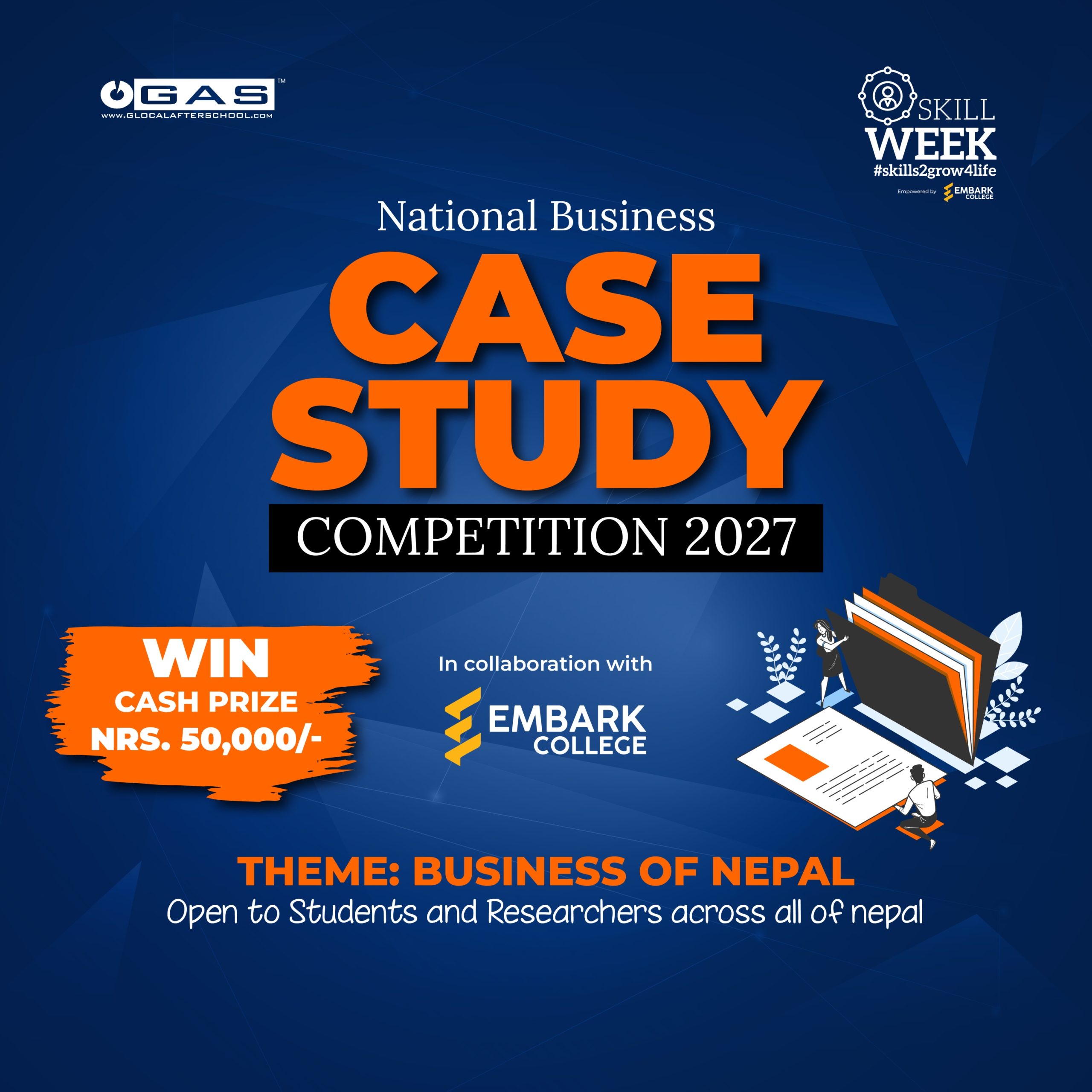
The National Business Case Study Competition 2027, organized by Glocal After School (GAS) as part of Skill Week 2027, provides youths across Nepal with a premier platform to examine real-world business challenges, conduct in-depth research, propose innovative solutions, and present their findings to a panel of experienced industry leaders.
Unlike previous editions restricted to specific sub-themes, this year features an open, nationwide focus: “Business of Nepal.” We are inviting students and researchers from all seven provinces—both inside and outside the Kathmandu Valley—to spotlight local enterprises, regional innovators, and homegrown businesses shaping Nepal’s economy. Furthermore, top-performing case studies will be officially published as part of Volume III of our Case Study Compendium!
What’s New in 2027?
- Nationwide & Out-of-Valley Participation: Open to students and researchers from every corner of Nepal. We strongly encourage teams to study businesses operating within their own local communities and provinces.
- Open Theme — “Business of Nepal”: No rigid sub-themes this year. Any compelling, real-life business operating in Nepal is eligible for study, provided it has not already been featured in Volume I or Volume II.
- No Duplicate Businesses (Volume III Exclusive): To ensure fresh insights for Volume III, businesses covered in Volume I, Volume II, or already claimed by another registered team for 2027 cannot be selected again. Participants must check the official list of already-covered businesses on our website before registering.
- Dedicated Online Mentoring & Drop-In Sessions: Selected teams will gain access to structured online mentoring sessions, preliminary orientation meetings, and drop-in feedback clinics to refine their research and writing.
- Official Publication Opportunity: Top case studies will be published in Volume III of the National Business Case Study publication.
FAQ
Teams work on a real-life business case. Each team registers its members and the name of the business it will study, and obtains the business’s consent for publication. Teams then submit drafts and receive mentoring and feedback. The Top 10 teams present their cases. The Top 4 teams, chosen by a panel of experienced judges, present in the final round before industry leaders and experts. The winning team is announced at the Skill Hero Award.
- Register before December 8.
- Applications are reviewed, and teams get recommendations on topic or business suitability. A preliminary online meeting then covers expectations, guidelines and the overall process.
- Submit the first draft online by December 14. Drop-in sessions will give feedback while you refine your case.
- Submit the final draft online by December 21. A coordination meeting follows the submission of required materials.
- The Top 10 teams are announced on December 28.
- The Top 10 present on January 15.
- The Top 4 present on January 16.
- The winner is awarded on January 18 at the Skill Hero Award.
Undergraduate and graduate students, groups of students, and researchers from anywhere in Nepal. You no longer need to be from the Kathmandu Valley.
Yes, we encourage it. Studying a local business from where you live or belong is a great way to bring regional enterprises into focus.
No. The theme is the Business of Nepal, and any Nepali business can be studied.
You can choose any business except those already covered in earlier case study volumes. Visit the website to see the list of businesses already taken before registering.
Yes. Before you begin the study, you must get the business’s consent for the case to be published. Branding requirements, including logos, promotional materials and consent collection, will be addressed with participants.
Yes. A preliminary online meeting will explain expectations and guidelines, selected participants receive online mentoring, and drop-in sessions will give additional feedback while you refine your case.
The top case studies will be published. Volume III will include businesses beyond those in Volumes I and II.
3–5 members.
No, participation is free.
If you have any questions, contact us at communication@glocalnepal.com.
The winning team will be awarded a cash prize and will have the opportunity to present their findings to industry leaders. But the competition is more than just a prize, it’s a chance to apply your classroom learning to real-world problems, and develop valuable skills in critical thinking, research, and communication.
To participate, assemble a team of 3-5 members and select a business from your community or region to study. You will then prepare a case study detailing the business’ sustainable initiatives, the impact they have had on the company and the community. The teams will present the case study to a panel of industry experts, who will evaluate the entries based on the quality of the research, analysis, and recommendations.
We connect students and companies in solving real-life challenges fostering Industry-Academia Collaboration and this is therefore a platform for students across the nation to exercise their current skill sets while simultaneously gaining new inspiration and expanding their horizon
Why Participate?
- Get Published (Volume III): Have your research formally published and recognized nationally, adding significant weight to your academic and professional portfolio.
- Practical Research Experience: Analyze real-world Nepali business operations, identify core challenges, and craft actionable strategies.
- Guided Mentorship: Receive direct guidance through preliminary orientation meetings, online mentoring sessions, and drop-in support clinics during your drafting phase.
- Exposure to Industry Experts: Present and defend your findings in front of Nepal’s top business leaders, entrepreneurs, and academic experts.
- Skill & Career Development: Sharpen critical thinking, field research, business writing, and executive presentation skills.
Eligibility Criteria
To participate in the National Business Case Study Competition 2027, applicants must meet the following criteria:
- Qualification Requirement: Undergraduate, Graduate
- Team Entry: Open to group of students (undergraduate, graduate, or independent youth researchers) from any province across Nepal.
- Local Focus Encouraged: Teams are highly encouraged to select a business from their own local area or home province.
- Unique Business Selection: The chosen business must not have been covered in Volume I or Volume II, nor already registered by another team for the 2027 edition (check the live list of covered businesses on our website before applying). Volume I , Volume II
- Mandatory Business Consent: Before initiating the study, participants must obtain formal consent from the selected business confirming that the case study will be published, along with necessary branding permissions (logos, promotional materials, and organizational data).
- Commitment: Must be committed, accountable, and willing to actively participate in online mentoring and coordination sessions.
Competition Timeline
| Date | Milestone |
|---|---|
|
November 18, 2026 |
Competition Announcement & Registration Opens |
|
December 8, 2026 |
Registration Deadline (Submit selected business & team details) |
|
December 14, 2026 |
First Draft Submission (Online) |
|
December 21, 2026 |
Final Draft Submission (Online) |
|
December 28, 2026 |
Top 10 Selection (Semi-Finalists Announced) |
|
January 15, 2027 |
Presentation of Top 10 Cases (Skill Fest) |
|
January 16, 2027 |
Grand Finale: Presentation of Top 4 Cases |
|
January 18, 2027 |
Awarding Ceremony at Skill Hero / Closing of Skill Week 2027 |
Competition Process & Format
- Verify & Secure Consent: Check our website to ensure your chosen Nepali business is unlisted (Volume I & II) or unclaimed for 2027, and obtain written approval for publication and logo usage.
- Register Online: Complete your online registration by December 8, 2026, and attend the preliminary online orientation on ethical guidelines, protocols, and formatting.
- Draft & Refine: Submit your First Draft by December 14, 2026, and participate in online mentoring and drop-in sessions for constructive feedback.
- Structure Your Case Study: Follow the standardized template covering six core sections: Background, Problem Statement, Objectives, Methodology, Analysis & Discussion, and Conclusion & Recommendations.
- Final Submission: Submit signed consent forms, high-resolution logos, and your final draft by December 21, 2026, ahead of the final coordination meeting and expert evaluation.
- Win & Publish: Compete for a NRs. 50,000/- cash prize at the Skill Hero awarding ceremony on January 18, 2027, and get officially published in Volume III of the National Business Case Study Publication.
Case Study Format
Please follow this format for consistency.
Preliminary Section
- Title Page: title of the case, author(s), affiliation, email
- Abstract (150–200 words) and Keywords (4–6)
Case Body Section
- Background / Context: describe the setting, organization or situation.
- Problem Statement / Research Question: what issue or phenomenon does the case explore?
- Objectives of the Case Study: educational or research goals.
- Methodology: qualitative or quantitative approach, data sources, period.
- Analysis and Discussion: findings, frameworks applied, implications.
- Conclusion and Recommendation: lessons learned, managerial and academic insights.
Supplementary Section
- References: APA 7th Edition.
The existing case study format will be shared with all registered participants.
Judging Criteria
All submissions will be reviewed by a jury, who will select the top 10 teams. Participants will be judged on the quality of the case chosen, the clarity and articulation of the written case, and the intent behind choosing that case. Teams will assess real issues that organizations face, analyze available information, craft solutions, and defend their recommendations before a jury of business leaders from Nepal.
Prize
The winning team will receive a cash prize of NRs. 50,000 at the Skill Hero Award on January 18, closing Skill Week 2027. The top case studies will also be published.